
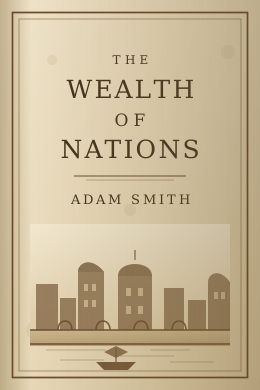
Coming soon · In preparation
The Wealth of Nations
An Inquiry into the Nature and Causes of the Wealth of Nations · Adam Smith · 1776
A landmark work of political economy, and the first book being prepared for quesread’s guided reading.
Not open yet. The guided edition is still in preparation, and the full book is not part of the live product today. People on the waitlist get early access first once part of it is ready.
About the book
Adam Smith published An Inquiry into the Nature and Causes of the Wealth of Nations in 1776. The book asks how nations produce wealth, how that produce is distributed, and which institutions and policies help or hinder the process. It is not a short treatise: Smith develops his argument across five books, with examples drawn from agriculture, manufacturing, trade and public finance.
That scale is part of why the book rewards guidance. quesread is preparing an edition that keeps Smith’s original text while breaking the reading into sections and placing questions where the argument turns.
The five books
-
Book I — Productivity and distribution
The division of labour, the origin and use of money, value and prices, wages, profits and rent. This is where the pin factory appears.
-
Book II — Stock and capital
The nature, accumulation and employment of stock; capital, productive and unproductive labour, and interest.
-
Book III — The progress of opulence
How different nations developed economically, including the relationship between towns and the countryside.
-
Book IV — Systems of political economy
The mercantile system, restrictions on imports and colonial trade, and the agricultural systems that Smith compares with it.
-
Book V — Revenue of the sovereign
The expenses of the sovereign or commonwealth, the sources of public revenue, and public debt.
Main themes
Division of labour
How splitting work into distinct operations can raise productivity, and why the extent of the market limits that division.
Markets and exchange
The human propensity to exchange goods, and the way exchange shapes specialization and trade.
Money
The origin and use of money as a common instrument of exchange, and its role in the wider economy.
Value and prices
Real and nominal price, the components of price, and the difference between natural and market price.
Trade and mercantilism
Smith’s examination of the mercantile system and its restrictions on imports and colonial trade.
Government and public finance
The expenses and revenue of the sovereign, and the problem of public debt, considered in Book V.
How quesread plans to guide your reading
The guided edition is being designed around the same four steps that shape quesread: read the original text, answer questions as you go, get AI grading with explanations, and review weak points later.
-
Read the original in sections
Smith’s text stays intact, but the long argument is divided into readable sittings with a clear sense of where you are.
-
Answer questions through each chapter
Questions ask you to explain key passages and connect ideas, so reading stays active rather than passive.
-
Get graded and explained
Answers are designed to be graded as correct, partially correct, wrong or skipped, with feedback that points back to the text.
-
Review what needs another look
Weak points return for spaced review, helping the book stay with you after the first reading.
These are planned features of the guided edition, not a live reading experience today. The waitlist is the first way to hear when part of the book is ready.
Why read it with guidance
The Wealth of Nations is long, and its ideas are easy to reduce to slogans once they are separated from the argument. Reading with questions slows that down. You meet Smith’s examples and distinctions in context, then explain them in your own words — which is a better test of understanding than recognizing a famous phrase.
If you have been curious about the book but have not made it through, that is exactly the reader quesread is designed for.
Be first in line for the guided edition
Join the waitlist and be the first to get early access.